


TicketLounge
AI-Powered Ticket Resale Platform
Next-Generation Ticket Marketplace
About the App and the Company
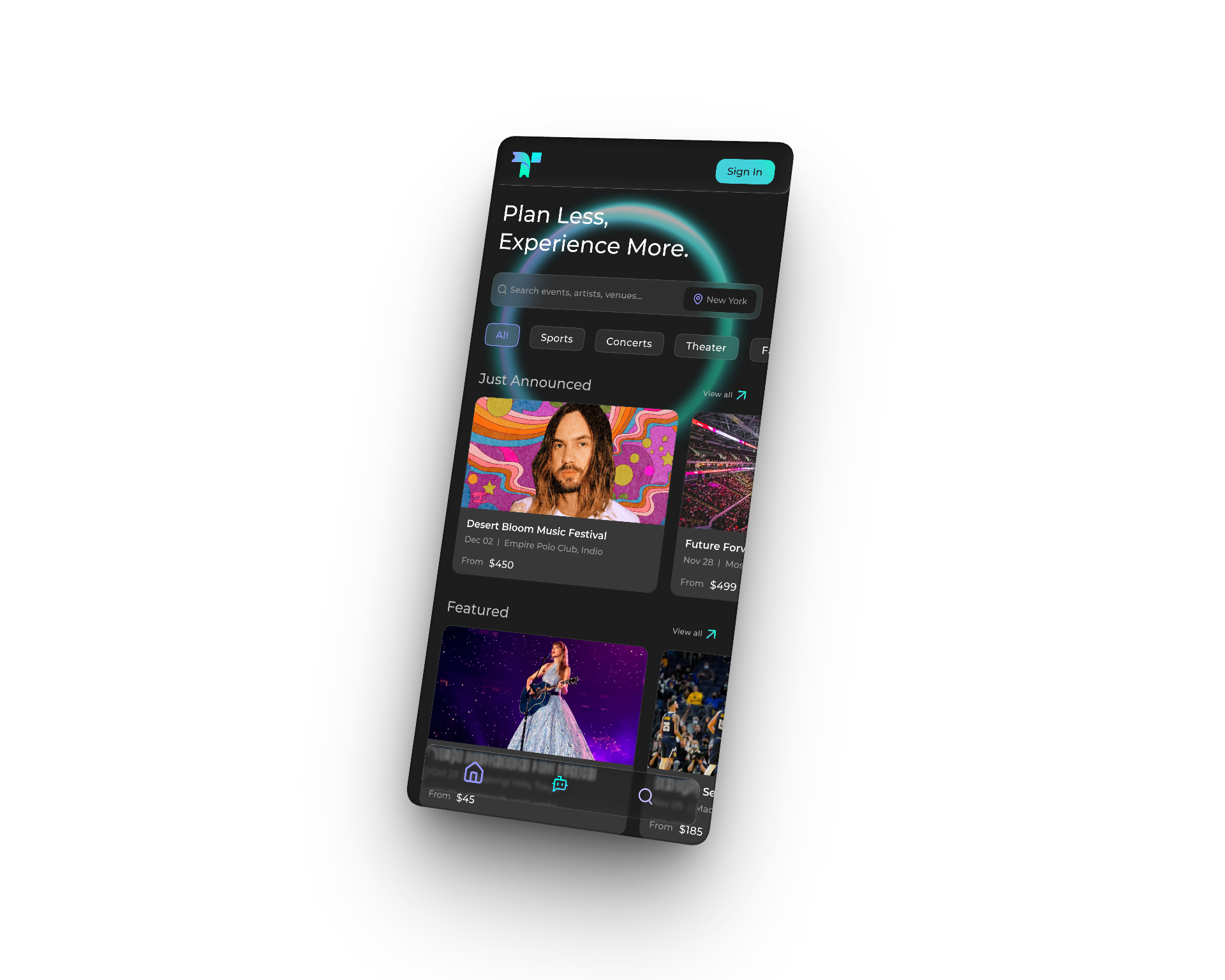
TicketLounge is a modern ticket resale marketplace designed to simplify how users discover, buy, and sell event tickets. The platform provides a seamless web and mobile experience, allowing users to browse events, explore seating options, and securely purchase tickets.
A key feature of TicketLounge is its AI-powered concierge, which enables users to search for tickets using natural language. Instead of relying on traditional filters, users can simply describe what they are looking for and receive intelligent results powered by semantic search.
The platform also includes an admin portal for managing events, importing listings, configuring seat maps, and maintaining ticket inventory. With integrated Stripe payments and automated event synchronization, TicketLounge delivers a scalable and efficient marketplace for ticket resale.
The Ask
TicketLounge approached DivNotes to design and build a modern ticket resale marketplace capable of supporting both web and mobile users while delivering a fast, intuitive ticket discovery experience. The platform needed to allow users to easily browse events, explore seating options, and securely purchase tickets through a seamless digital interface.
One of the core goals was to introduce an AI-powered concierge that would allow users to search for tickets using natural language. Instead of relying on traditional filters and manual browsing, the platform needed to understand user intent and return relevant ticket listings quickly and accurately.
In addition to the consumer-facing applications, TicketLounge required a powerful administrative system for managing events, importing listings, configuring venue seat maps, and maintaining ticket inventory. The platform also needed to support secure payment processing through Stripe and handle real-time marketplace activity as new events and listings were added.
To meet these requirements, TicketLounge needed a scalable architecture capable of supporting cross-platform applications, complex event data, and intelligent search capabilities — all while ensuring performance, reliability, and a smooth user experience across devices.
The Approach
DivNotes focused on building a scalable marketplace platform capable of supporting web and mobile applications while delivering a fast and intuitive ticket discovery experience. The system architecture was designed to allow rapid product development while maintaining performance and scalability.
To streamline development across platforms, we implemented a modern monorepo architecture that allowed the web application, mobile apps, and admin dashboard to share core components and business logic. This ensured a consistent user experience across devices while simplifying long-term maintenance.
The platform was built using modern web and mobile frameworks, enabling users to browse events, explore seating options, and securely purchase tickets. On the backend, we implemented a scalable API layer supported by PostgreSQL and Supabase services, which provide authentication, database management, and serverless functions for background tasks and event synchronization.
A key innovation of the platform is the AI-powered concierge search. Using semantic search with vector embeddings and intelligent query processing, users can describe the tickets they are looking for in natural language and instantly receive relevant results.
To support marketplace operations, we also developed an admin portal for managing events, importing listings, configuring venue seat maps, and maintaining ticket inventory. Secure payments were integrated through Stripe, ensuring reliable and compliant transaction processing.
This architecture enables TicketLounge to support growing event listings, marketplace activity, and AI-driven discovery while maintaining a smooth and responsive user experience across web and mobile platforms.
Challenges & Solutions
People rarely search the way a database expects. Someone might type "rap concerts this weekend near me" or "seats behind home plate under fifty dollars," and the older approach would often come back empty or, worse, show the wrong team or the wrong night. Getting it to understand loose, everyday language and still land on the right handful of events was the hard part.
We built a concierge that reads the intent behind a request and searches several ways at once, then ranks what actually fits. When an exact match is thin, it loosens one thing at a time, say widening the dates, and tells the person what it changed instead of quietly showing something off target. If it genuinely has nothing good, it says so rather than padding the list with filler.
Ticket prices and what's still available change constantly, and the catalog is large enough that you can't refresh all of it in one pass. We needed to keep everything current with many small jobs running on a schedule, but running several at once tended to make them collide or slow the live search to a crawl.
We changed how the refresh jobs pick up work so each one quietly claims its own batch and skips anything another job already has, which lets several run side by side without stepping on each other. We also separated the "when did we last check this" bookkeeping from the data search depends on, so keeping things fresh no longer competes with people actually searching. Each run also knows to stop before it hits its time limit and picks up where it left off next time.
When someone pays, we charge their card through Stripe, but the actual tickets come from a separate supplier, and that second step can be slow or fail after the card is already charged. Payment confirmations can also arrive more than once or out of order, so the same purchase could accidentally get processed twice. Getting the money, the tickets, and our own records to always agree was genuinely tricky.
We rebuilt the payment flow so a confirmation is only ever acted on once, no matter how many times it arrives or how the messages overlap. If the supplier can't complete the purchase after the card was charged, the system refunds the customer automatically instead of leaving them paying for nothing. And before any order goes through, we re-check the live price and availability so nobody is charged the wrong amount or sold a ticket that just disappeared.
A stadium seat map is a dense, awkward graphic, and we wanted people to do more than stare at it: tap a section to pick it, pinch to zoom, and see at a glance which areas are cheaper or pricier. The raw maps we receive are just shapes with no easy way to know where each section sits or how to frame it when someone taps, so making the map feel responsive and readable took real work.
We worked out, from the raw shapes alone, exactly where every section lives so a tap can zoom straight to it and snap back out cleanly. We color the sections by price so the cheaper and more expensive areas read instantly, and the map resizes smoothly as you drag the ticket list up and down. The result is a map you can explore and understand at a glance instead of squinting at a flat picture.
We build the iPhone app, the Android app, and the website from a single shared codebase, which keeps everything consistent but means a problem on one platform can be invisible on the others. A couple of the nicer visual touches turned into real traps: an animated background that froze the iPhone app whenever you moved between screens, and a frosted glass look that ate memory on iPhone and made scrolling stutter on Android.
We kept the shared codebase but gave each platform its own version of the tricky pieces, so every device gets the smooth, native version that suits it. The animated background was rebuilt a different way on iPhone so it no longer hangs, and the glass effect now uses Apple's built-in version on newer iPhones with lighter fallbacks elsewhere. People get an app that feels at home on their device, and we still ship from one place.
The Results & Impact
The launch of TicketLounge delivered a modern, scalable ticket resale marketplace capable of supporting both web and mobile users while providing a faster and more intuitive ticket discovery experience.
Key outcomes included:
A fully integrated web and mobile platform, allowing users to discover and purchase tickets seamlessly across devices.
AI-powered concierge search, enabling users to find tickets using natural language rather than complex filters.
A scalable marketplace architecture capable of managing large numbers of events, listings, and transactions.
Secure and reliable payment processing through Stripe, ensuring safe and efficient ticket purchases.
A comprehensive admin portal for managing events, importing listings, configuring venue seat maps, and monitoring marketplace activity.
Automated event synchronization and streamlined event management workflows, reducing manual operational overhead.
Technology Stack



Looking for Reliable Software Solutions?
No matter your software development needs, we’ve got you covered. Whether you're building a new application, optimizing an existing system, or looking for expert guidance on your next big project, we’re here to help. Let’s start with a free discovery session. Tell us what you need, and we’ll explore the best possible solutions tailored for you. No commitments, just a friendly chat to help you understand what to do.
More Projects like this


Musician Collaboration Platform